The Real Impact of AI Agents on Small Businesses in 2026
Discover how AI agents for business are transforming small business operations in 2026—moving beyond hype into real automation, productivity, and growth.
AI AUTOMATION
ND
3 min read
Introduction: AI Agents Are No Longer Experimental
For years, AI agents were discussed as futuristic assistants—promising productivity gains but rarely delivering measurable results. In 2026, that narrative has changed. AI agents for business are now embedded in real workflows, quietly handling tasks that once required full-time staff, constant supervision, or complex software stacks.
For small businesses in particular, this shift is significant. Limited resources, lean teams, and operational overload make efficiency not a luxury—but a necessity. The question is no longer whether AI agents will matter, but how they are already reshaping everyday business operations.
What Are AI Agents—In Practical Terms?
AI agents are autonomous or semi-autonomous systems that can plan, execute, and adapt tasks toward specific business goals. Unlike traditional automation tools that follow fixed rules, AI agents can:
Interpret context
Make decisions across multiple steps
Interact with software, data, and users
Improve performance over time
In simple terms, they act less like tools and more like junior operators—handling defined responsibilities without constant instruction.
Why 2026 Is the Tipping Point for Small Businesses
Several converging trends have pushed AI agents from hype into adoption:
1. Maturity of Language and Reasoning Models
Modern AI systems can now handle nuanced instructions, business logic, and multi-step workflows reliably—something earlier tools struggled with.
2. No-Code and Low-Code Integration
AI agents can be deployed without deep technical expertise, allowing founders and operators to design workflows visually rather than through complex programming.
3. Cost Accessibility
What once required enterprise budgets is now available through subscription-based tools, making AI automation feasible for small teams.
4. Operational Pressure
Rising customer expectations, global competition, and remote work have increased complexity—forcing businesses to automate or fall behind.
Real Use Cases: Where AI Agents Deliver Actual Value
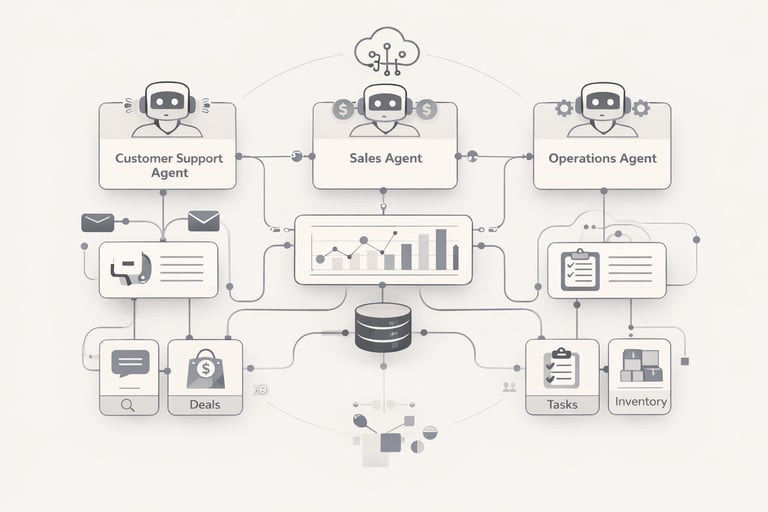
Customer Support Without Scaling Headcount
AI agents now manage:
First-response customer queries
Ticket categorisation and prioritisation
Knowledge-base updates
Escalation logic for complex cases
This reduces response times while keeping human teams focused on high-value interactions.
Sales and Lead Management
AI agents for business are actively involved in:
Lead qualification and scoring
Automated follow-ups
CRM data updates
Proposal drafting
Instead of replacing sales teams, these agents remove friction—ensuring no opportunity is lost due to manual delays.
Operations and Back-Office Automation
Small businesses increasingly use AI agents to:
Process invoices and receipts
Monitor inventory levels
Reconcile transactions
Generate operational reports
This level of automation was previously available only to larger organisations with dedicated ops teams.
Marketing and Content Workflows
AI agents support marketing by:
Researching trending topics
Drafting content outlines
Repurposing content across platforms
Analysing performance metrics
Importantly, human oversight remains critical—but the time cost drops dramatically.
The Contrarian Insight: AI Agents Don’t Replace Teams—They Reshape Them
The fear that AI agents will eliminate jobs misses the real impact. In practice, small businesses are not firing employees en masse. Instead, they are:
Reducing operational drag
Eliminating repetitive cognitive work
Allowing teams to focus on strategy, creativity, and relationships
The most successful adopters treat AI agents as capacity multipliers, not replacements.
Key Challenges Small Businesses Must Navigate
Despite the benefits, AI agent adoption is not without risk.
Over-Automation
Not every process should be autonomous. Poorly designed agents can create errors at scale.
Data Quality Issues
AI agents are only as effective as the data they access. Fragmented or outdated data limits impact.
Governance and Oversight
Clear boundaries, audit trails, and human checkpoints are essential to maintain trust and compliance.
How to Start Using AI Agents Strategically
For small businesses exploring AI agents in 2026, the smartest approach is incremental:
Start with one high-friction process
Define clear success metrics
Maintain human review in early stages
Expand only after reliability is proven
AI agents work best when they are purpose-built, not broadly deployed without intent.
What’s Next: From Task Automation to Decision Support
The next evolution of AI agents for business is not just execution—but decision assistance. Emerging systems can:
Simulate business scenarios
Recommend pricing strategies
Flag financial or operational risks
Support long-term planning
This marks a shift from automation toward augmented intelligence—where AI becomes a strategic partner rather than a background tool.
Conclusion: AI Agents as a Structural Advantage
In 2026, AI agents are no longer experimental add-ons. For small businesses, they represent a structural advantage—unlocking scale, efficiency, and resilience without proportional cost increases.
The real differentiator will not be access to AI, but how thoughtfully it is integrated into operations.
As AI agents continue to mature, the most important question becomes:
Which parts of your business should remain human-led—and which are ready to evolve?
Our Address:
Nifame Digitals Gurugram, Haryana Pincode - 122 001
Contact
info@nifamedigitals.com
+91 8851743498
. © 2025 All Rights Reserved. Nifame Digitals, Gurugram, India